





If you want a Balkan road trip that feels different from the usual beach-and-old-town route, this one has a strong case. Instead of focusing only on the coast, it links two of the region’s most striking karst water sites: Albania’s Blue Eye and Croatia’s Red Lake. The route is short enough to do in under a week, but varied enough to feel like more than a simple drive between two viewpoints.
Calling them “cenotes” is a useful way to frame the trip, even if the word belongs more naturally to Mexico. What matters for travellers is the shared appeal: intensely coloured water, collapsed limestone landscapes, and places that look far stranger than the standard Adriatic itinerary. If you are already planning a broader regional trip, this route also fits naturally with our Croatia travel guide and wider Europe destination pages.
What is this route actually like?
This is best thought of as a 5 to 7 day Balkan road trip linking one famous spring in southern Albania with one dramatic sinkhole in inland Croatia. It works best for people who like scenic drives, short walks, unusual natural landmarks and smaller detours rather than nonstop city sightseeing.
It is not a swimming holiday, and it is not really a one-theme geology trip either. The appeal is the contrast between the two sites and the drive between them.
Why this route works
- it gives you a more unusual alternative to a standard Adriatic road trip
- both headline stops are visually distinctive
- the drive passes through strong overnight bases
- you can combine coast, mountains, small towns and natural sites in one trip
- it works in shoulder season better than many beach-heavy routes
Stop 1: Albania’s Blue Eye
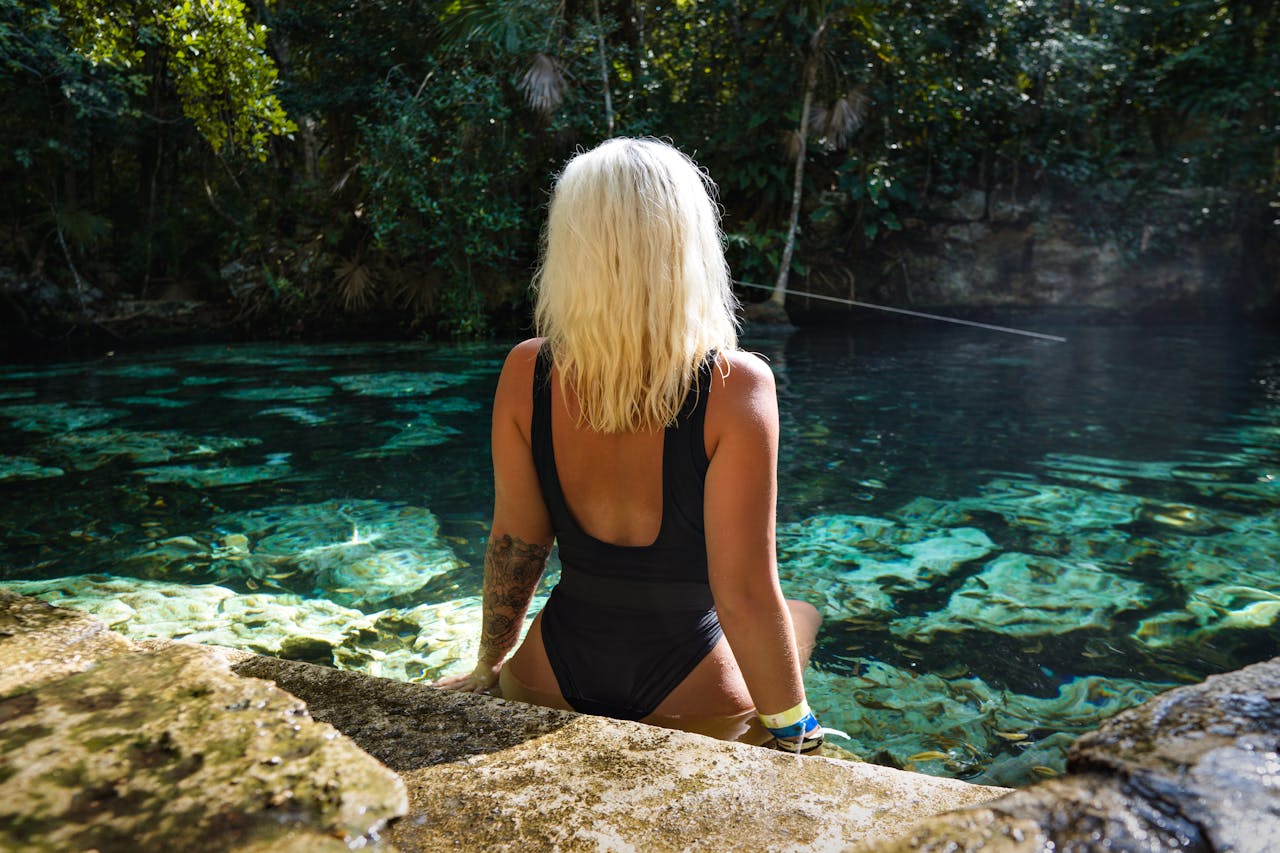
The Blue Eye, or Syri i Kaltër, is the softer and more accessible half of the route. It is a vivid spring surrounded by trees, with the water shifting from pale turquoise at the edges to a much darker central blue. It is one of those places that looks edited even when it is not.
The site works best as a half-day stop rather than something to overbuild your trip around. The point is the setting, the colour and the short walk in, not a long checklist of activities.
What to expect at the Blue Eye
- a clear spring in a wooded setting
- bright blue and turquoise water
- short walking access from the parking area
- a quick stop that fits easily into a wider south Albania route
The water remains cold throughout the year, which is part of the attraction visually but limits how many people actually want to get in. Some visitors do go into the water, but it is better to approach the site with care given its sensitivity and local importance.
Best time to visit the Blue Eye
Early morning or later afternoon is usually the best choice. The light is softer, the crowds are lighter, and the site feels less like a quick group-tour stop.
If you are travelling in peak summer, the difference between arriving early and arriving late can shape the whole experience.
How to get to the Blue Eye
The Blue Eye is usually visited from Sarandë or as part of a wider south Albania route.
Best base
- Sarandë for the easiest access and overnight stay
Getting there
- By car: the easiest option if you are building a road trip
- By bus and walk: possible, but less convenient
- By tour: fine if you are already based nearby and do not want to drive
This is one of the places on the route where having your own car makes the trip much easier.
The drive north: how to structure the route
The original version tries to make the transfer sound like one simple scenic run, but in practice this is the section that needs the most planning. You are not just moving between two natural sites. You are crossing several country segments and deciding whether to keep the trip coastal, inland or split across one or two overnight stops.
For most people, the smartest version of the route is not a direct push from Albania to Imotski. It is a broken journey with at least one overnight stop.
Best overnight stops between Blue Eye and Red Lake
| Stop | Why it works | Best for |
|---|---|---|
| Sarandë | easiest base before or after Blue Eye | south Albania start |
| Kotor | dramatic bay setting and easy Montenegro stop | scenic overnight |
| Mostar | strong historical detour inland | breaking up the drive |
| Split | practical city stop before heading inland to Imotski | city-and-nature mix |
| Makarska Riviera | shorter coastal base near the final stop | seaside break |
You do not need to include all of these. One or two is enough.
Suggested road-trip versions
5-day version
- Day 1: Sarandë and Blue Eye
- Day 2: Drive towards Montenegro, overnight in Kotor
- Day 3: Continue north, overnight near Split or Makarska
- Day 4: Visit Red Lake and Imotski area
- Day 5: Return or continue through Croatia
7-day version
- Day 1: Arrive in Sarandë
- Day 2: Blue Eye and south Albania
- Day 3: Kotor
- Day 4: Mostar
- Day 5: Split or Makarska
- Day 6: Red Lake and Imotski
- Day 7: Extra day for Blue Lake, Biokovo or onward Croatia travel
The longer version is better because it lets the route feel like a trip rather than a transfer exercise.
Stop 2: Croatia’s Red Lake
Red Lake, near Imotski, is the more dramatic and less casual half of the route. Unlike the Blue Eye, this is not a place you come to dip into the water or linger beside a riverbank. It is a viewpoint-led stop built around scale, colour and the shape of the sinkhole itself.
Local and regional Croatian tourism sources describe it as a rare karst phenomenon formed by collapse, near Imotski, with water depth commonly cited at around 281 to 287 metres depending on source. That is enough to make the point without overclaiming. The official tourism pages for the area are useful if you want current visitor context: Visit Imota’s Red Lake page and the wider Imotski destination page.
What to expect at Red Lake
- a huge collapsed karst sinkhole near Imotski
- red-toned cliffs above dark green water
- viewpoints rather than water access
- a short stop that works best as part of a wider Imotski visit
This is a stronger stop for photographers, road trippers and people who enjoy unusual natural landforms than for those looking for a long activity list.
Can you swim at Red Lake?
No, not in any practical or standard visitor sense. The site is about looking into the lake from above, walking the surrounding viewpoints and combining it with the nearby Blue Lake and Imotski itself.
That is one of the main differences between the two headline stops on this route. The Blue Eye feels close and immediate. Red Lake feels distant, steep and more dramatic.
What else to see near Red Lake
If you are driving all the way to Imotski, it makes sense to add one or two nearby stops rather than treating Red Lake as a five-minute detour.
Worth adding nearby
- Blue Lake (Modro Jezero) for a second karst landmark in the same area
- Imotski old town for a short walk and break from the road
- Makarska Riviera if you want to balance inland scenery with the coast
- Biokovo area if you are continuing into a bigger Dalmatian route
This is where the article gains more practical value than the original. The trip becomes easier to imagine once the final stop is treated as part of a wider area rather than as a single dramatic photo point.
Best time to do this route
This route is strongest in shoulder season.
| Season | What to expect |
|---|---|
| April to June | mild temperatures, greener scenery, better road-trip conditions |
| July to August | busier coast, hotter inland stops, tougher midday conditions |
| September to October | warm enough for a road trip, softer crowds, better pace |
| Winter | quieter roads, but less reliable weather and shorter daylight |
For most people, late spring or early autumn is the best answer. The sites look good in summer, but the driving days and exposed viewpoints are more comfortable outside peak heat.
Practical tips for doing the “secret cenote” route well
Choose the right car
A small hire car is enough. You do not need anything special, but compact size helps in older towns and tighter parking areas.
Do not overpack the route
This trip works because the two water sites are distinctive. Add too many extras and it loses shape.
Plan border crossings sensibly
This is not a difficult route, but it is still a multi-country drive. Check your rental terms properly, especially if you are crossing borders.
Treat the headline stops as short visits
Neither place needs a full day. They are strong because they are unusual, not because they are activity-heavy.
Pack for short walks and bright conditions
Good shoes, water, a hat and simple sun protection matter more here than specialist gear.
Is Europe’s “secret cenote circuit” actually worth doing?
Yes, if you like unusual landscapes and want a road trip that feels more original than another standard coast-and-old-town loop.
The idea works best when you stop treating it as a gimmick and see it for what it is: a compact Balkan route linking two highly photogenic karst sites with some very good overnight stops in between. The Blue Eye gives you colour, shade and closeness. Red Lake gives you scale, depth and a much harsher kind of drama. They do not look alike, but that is exactly why the pairing works.
FAQs
Yes, especially if you are already in Sarandë or travelling through southern Albania. It is best as a short scenic stop rather than a full-day outing.
Yes, if you are interested in unusual natural sites and are already travelling through Dalmatia or inland from Split or Makarska.
Five days is the minimum for a proper version of the trip. Seven days gives it a much better pace.
The Blue Eye is the one associated with water access, though conditions are cold and the site should be treated carefully. Red Lake is a viewpoint stop rather than a swimming place.
Sarandë is the easiest and most practical base.
Imotski works if you want to stay close, while Makarska is a good option if you prefer to base yourself nearer the coast.