









Blue Lake, or Modro Jezero, is one of Croatia’s most unusual inland sights. It sits below the town of Imotski, surrounded by steep limestone walls, and its water level changes dramatically through the year.
That changing water is the first thing to understand before planning night kayaking here. Blue Lake is not a fixed, year-round kayaking venue. In some seasons, the water can be high enough for paddling. In dry periods, it may become too shallow, rocky or even partly dry.
A night kayaking trip inside Blue Lake can be memorable if local conditions are right. It needs proper planning, a local operator, safe water depth and a careful approach after dark.
At VayCay Couple, we would treat this as a conditional adventure rather than a guaranteed activity. Plan the Blue Lake visit first. Add kayaking only if the lake, access and local advice make it safe.
For a daytime version of the same trip, read our Blue Lake kayaking itinerary in Croatia.
Where is Blue Lake in Croatia?
Blue Lake is in Imotski, a town in Croatia’s Dalmatian hinterland. It sits inland from the Makarska Riviera and is usually visited by car from Split, Makarska or nearby coastal towns.
| Quick fact | Detail |
|---|---|
| Local name | Modro Jezero |
| Location | Imotski, Dalmatia |
| Best known for | Blue water, steep limestone walls, seasonal water levels |
| Nearby sight | Red Lake, or Crveno Jezero |
| Best access | By car |
| Good trip length | Half day to full day |
| Main warning | Water level changes a lot |
Imotski itself is worth a short stop. The town has viewpoints, stone streets, cafés and Topana Fortress above the Blue Lake area.
Is Blue Lake really a cenote?
Blue Lake is often compared with a cenote because of its steep-sided, sinkhole-like shape and clear water. Technically, it is a karst lake in a collapse doline rather than a Mexican-style cenote.
The comparison helps explain the feel of the place. You look down from the rim, follow a path into the crater and reach water enclosed by high rock walls. From below, the lake feels separate from the town above.
For travellers interested in this kind of landscape, our wider cenotes section covers similar natural swimming and sinkhole-style places beyond Croatia.
Can you go night kayaking at Blue Lake?
Possibly, but only if a local operator is running a safe trip and the water level is suitable.
Blue Lake is a natural site, not a permanent night kayaking centre. Do not arrive expecting to hire a glowing kayak on the spot. Night paddling needs more checks than daytime kayaking because the path, launch area, shoreline and return climb are harder after dark.
Before booking, ask:
- Is the water level high enough for kayaking?
- Is there an approved local operator?
- Are life jackets included?
- Is a guide on the water at all times?
- How do you descend and return after dark?
- Is the route affected by rocks or shallow water?
- What happens if the wind picks up?
- Is the trip cancelled if conditions are poor?
If the answer to any of these is unclear, do a daytime visit instead.
When is Blue Lake most likely to be kayakable?
Blue Lake is most likely to have higher water in spring and early summer. Later in summer and autumn, the water can fall sharply.
| Season | Likely conditions | Night kayaking potential |
|---|---|---|
| March to May | Higher water, cooler evenings | Better chance, but check local access |
| June | Often warmer, water may still be suitable | One of the better windows |
| July to August | Hot, water may drop | Possible in some years, not guaranteed |
| September to October | Water can recede quickly | Less reliable |
| November to February | Variable weather and access | Usually not the main window |
The official local information for Blue Lake notes the built path down to the water and the close link between the lakes and Imotski’s natural setting. The key practical point is still simple: check water level locally before planning any paddle. (visitimota.croatia.hr)
Why is Blue Lake’s water level so important?
Blue Lake’s water level changes because it is part of a karst system. Water can rise and fall with rainfall, underground flow, evaporation and seasonal conditions.
That affects everything:
- whether kayaking is possible
- how far you need to carry equipment
- where you can launch
- how safe the shoreline is
- whether rocks are exposed
- how hard the climb out feels after the activity
- whether swimming or paddling is allowed
In some dry years, Blue Lake can partly or fully dry out. When that happens, the visit becomes about walking, viewpoints and the strange empty basin, not kayaking.
How do you get to Blue Lake from Split?
The easiest way to reach Blue Lake is by car. From Split, the drive usually takes around 1 hour 15 minutes to 1 hour 30 minutes, depending on traffic and route.
A common route is to drive inland towards the A1 motorway, exit towards Zagvozd, then continue to Imotski. From Makarska, the journey is usually shorter, but mountain and tunnel routes can affect timing.
| Starting point | Best way to visit |
|---|---|
| Split | Car or organised inland day trip |
| Makarska | Car or private transfer |
| Dubrovnik | Too far for a simple day trip |
| Imotski town | Walk or short local transfer to viewpoints |
| Red Lake | Short drive or walk from Blue Lake area |
Public transport is more limited than coastal Croatia.
What should a Blue Lake night kayaking plan look like?
Keep the plan simple. The lake, path and lighting make this a slow activity, not something to squeeze between other stops.
| Time | Plan |
|---|---|
| Late afternoon | Arrive in Imotski, check conditions and meet operator |
| Early evening | Visit the rim viewpoints while there is still light |
| Sunset | Walk down the path with guide and equipment plan |
| After sunset | Short guided paddle if conditions are safe |
| Mid-paddle | Lights low or off for a quiet stop, if allowed |
| End of trip | Return to the launch point and pack up |
| After paddling | Hike back up with headlamps |
| Later evening | Simple dinner or drink in Imotski |
Do not make the paddle too long. The descent, launch, return and climb all take time, especially after dark.
What is nightglow kayaking?
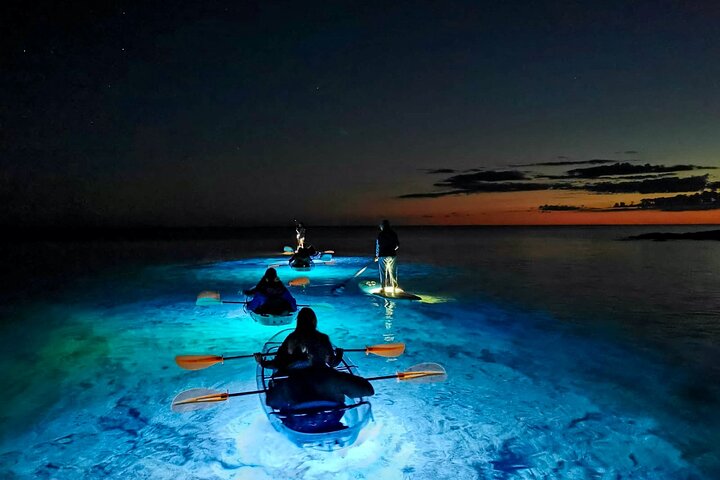
Nightglow kayaking usually means paddling after dark in kayaks fitted with LED lights, often with clear or partly transparent hulls. The lights make the water and boat glow, creating a bright effect on calm water.
It is popular in some coastal destinations because it photographs well and feels different from normal kayaking.
At Blue Lake, the appeal would be the enclosed setting. The cliff walls, still water and darker inland location could make the light effect stronger than on a busy coast. That said, the same setting also increases the need for care.
Is night kayaking at Blue Lake safe?
It can only be considered safe with the right conditions, equipment and guide. It should not be done independently.
Main risks include:
- uneven path down to the lake
- low light on the return climb
- changing water depth
- exposed rocks
- limited exit points
- poor mobile signal in parts of the crater
- no lifeguards
- cooler air after sunset
- sudden weather changes
- lack of fixed lighting
A safe operator should provide life jackets, route advice, lighting, group control and a clear cancellation policy.
If there is no guide, no safety briefing or no clear plan for getting back up after dark, do not go.
What gear do you need for Blue Lake night kayaking?
Bring light, practical gear. You need to think about both paddling and the walk in and out.
| Item | Why it helps |
|---|---|
| Life jacket | Essential on the water |
| Headlamp | Needed for the return path |
| Trail shoes | Better grip on the rocky route |
| Dry bag | Protects phone and valuables |
| Light jacket | Evenings can cool down |
| Water bottle | Useful before and after the climb |
| Phone with offline map | Helps around Imotski and parking |
| Small towel | Useful after paddling or splashes |
| Power bank | Keeps phone and light backup ready |
| Insect repellent | Useful in warmer months |
Avoid carrying too much. The climb back is easier with a light bag.
Can beginners do Blue Lake night kayaking?
Beginners should only do it with a calm-water, guided tour and suitable conditions. Blue Lake is not the right place for a first unsupervised night paddle.
A beginner-friendly trip should have:
- calm weather
- short route
- small group
- clear launch area
- good water depth
- proper life jackets
- guide support
- easy return plan
If you have never kayaked before, a daytime paddle is the better first choice.
What can you do if night kayaking is not possible?
A cancelled paddle does not mean the trip is wasted. Blue Lake and Imotski still work well without kayaking.
Good alternatives include:
- sunset from the rim viewpoints
- a daytime walk down into the lake crater
- swimming if access and conditions allow
- Red Lake viewpoints
- Topana Fortress
- dinner in Imotski
- a wine stop in the Dalmatian hinterland
- a return visit in spring or early summer
Red Lake is especially easy to add. Official local tourism information notes that it is around 1.5 km from Blue Lake, making the two lakes a natural pair in one visit. (english.visitimota.com)
For wider planning, our Croatia travel guide can help you connect Imotski with Split, Makarska, islands and inland stops.
Should you visit Red Lake too?
Yes, if you are already in Imotski. Red Lake, or Crveno Jezero, is a steep karst lake close to Blue Lake. It is viewed from above rather than used for swimming or kayaking.
Blue Lake gives you access down into the crater when conditions allow. Red Lake gives you the dramatic viewpoint. Together, they make the trip feel more complete.
Visit Blue Lake first if you want to check water level and access. Add Red Lake before sunset or the next morning if the evening is focused on kayaking.
Is Blue Lake good for stargazing?
Blue Lake can feel dark and quiet compared with the coast, but it is not a formal dark-sky site. Light from Imotski and local roads may still be visible.
For a guided night paddle, a short lights-off pause may be possible if conditions are safe and the group is controlled. Keep this quiet and low-impact. The rock walls can carry sound, so loud music and bright flashing lights are a poor fit for the setting.
How do you protect Blue Lake when visiting?
Blue Lake is a natural site, not a theme park. Keep the impact low.
Simple rules:
- take all rubbish back out
- do not leave food or drink packaging
- avoid loud music
- do not use flashing lights near wildlife
- stay on marked paths where possible
- follow local signs
- do not jump from rocks unless signs and conditions clearly allow it
- do not damage plants or rock edges
- use toilets before descending if facilities are limited
- respect local advice if access is closed
A quieter visit is better for the place and usually better for the experience.
Blue Lake night kayaking or daytime kayaking: which is better?
| Choose daytime kayaking if you want | Choose night kayaking if you want |
|---|---|
| Easier access and visibility | A more unusual experience |
| Better for beginners | A guided short paddle |
| Clearer views of the cliffs | LED glow and darker atmosphere |
| Better photos of the lake colour | Night photos and reflections |
| Lower safety complexity | A slower, more controlled activity |
For most travellers, daytime kayaking is the safer first choice. Night kayaking is better as a special add-on if a reliable operator confirms conditions.
Can you combine Blue Lake with a Split or Makarska trip?
Yes. Blue Lake fits well as a day trip from Split or Makarska, especially if you have a car.
A simple route from Split could be:
| Time | Plan |
|---|---|
| Morning | Leave Split and drive to Imotski |
| Late morning | Blue Lake viewpoints and walk |
| Lunch | Imotski café or local restaurant |
| Afternoon | Red Lake viewpoints |
| Evening | Night kayaking if safely available |
| Night | Return to Split or stay nearby |
If you plan to paddle after dark, consider staying near Imotski or Makarska rather than driving a long route back late at night.
Blue Lake night kayaking is best treated as a special possibility, not a fixed plan. The setting is unusual, but the lake decides what is possible.
Check the water level, speak to local operators, go with a guide and keep the trip short and safe. If conditions are not right, do not force it. Blue Lake is still worth visiting for the viewpoints, crater walk, Red Lake and Imotski itself.
FAQs
Only if a local operator is running a guided trip and conditions are safe. Blue Lake is seasonal, and water levels can change heavily, so night kayaking is not guaranteed.
Blue Lake is in Imotski, inland from the Makarska Riviera in Dalmatia. It is usually visited by car from Split or Makarska.
No. Blue Lake and Red Lake are separate natural sights near Imotski. Blue Lake has a path down to the water. Red Lake is mainly viewed from above.
Spring and early summer usually give the best chance of suitable water levels. April, May and June are often more reliable than late summer, but conditions vary each year.
Daytime kayaking may suit beginners when conditions are calm and a local operator is present. Night kayaking is more complex and should only be done with a guide.
Swimming can be possible when water levels, access and local conditions allow it. Always check signs and local advice before entering the water.
Yes. Night kayaking at Blue Lake should be guided. The site has uneven access, changing water levels, limited lighting and no lifeguard-style setup.
Blue Lake is usually around 1 hour 15 minutes to 1 hour 30 minutes from Split by car, depending on traffic and route.
Wear quick-drying clothes, trail shoes for the path, a light jacket and a life jacket on the water. Bring a headlamp for the climb back.
If Blue Lake is dry or too shallow, kayaking is not possible. You can still visit the viewpoints, walk into the crater if access is open, visit Red Lake and explore Imotski.