










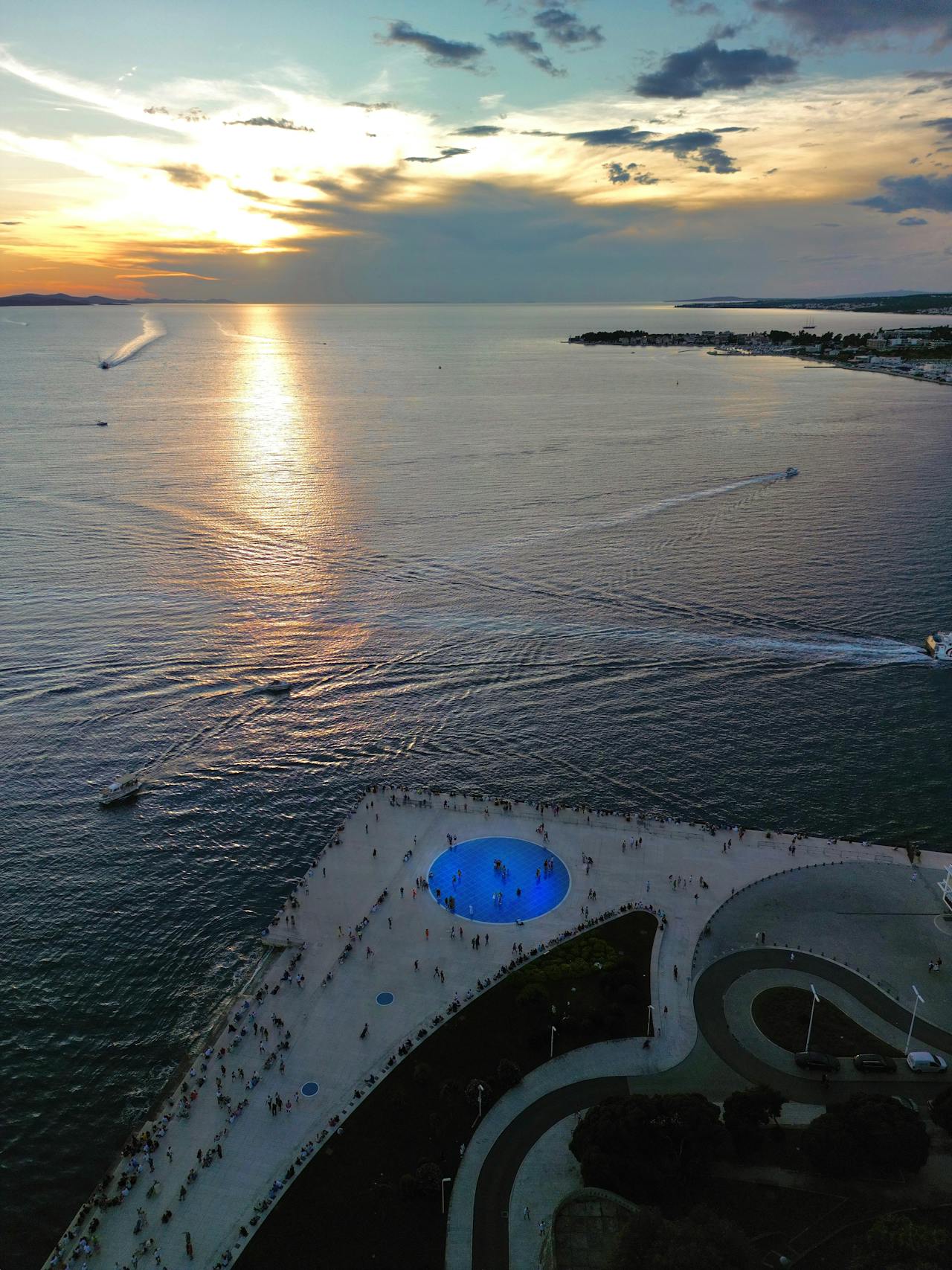
The Greeting to the Sun is one of the easiest places to visit in Zadar, but timing matters. In the middle of the day, it can look like a large glass circle set into the waterfront. Around sunset, with the Sea Organ playing beside it and the sky changing over the islands, it makes much more sense.
This is not a long attraction. It is a short, open-air stop that works because of where it sits: at the western end of Zadar’s old town peninsula, facing the sea, right beside one of Croatia’s most unusual sound installations.
If you are visiting Zadar for one evening, this is the place to be before dusk.
What is the Greeting to the Sun?
The Greeting to the Sun, also known as Pozdrav Suncu, is a solar-powered light installation on Zadar’s waterfront. It is made from hundreds of glass plates set into the stone promenade.
During the day, the panels collect solar energy. After sunset, the installation lights up with changing colours and patterns.
The official Zadar Tourist Board describes it as an installation made of 300 multi-layered glass plates that absorb solar energy during the day and create a waterfront light show after sunset.
It was designed by Croatian architect Nikola Bašić, the same architect behind the Sea Organ nearby.waves to create sound. Together, the two installations are what make this section of Zadar’s waterfront feel different from a standard promenade walk.

Where is the Greeting to the Sun?
The Greeting to the Sun is on the western point of Zadar’s old town peninsula, beside the Sea Organ and the waterfront promenade.
| Detail | What to know |
|---|---|
| City | Zadar, Croatia |
| Area | Old town waterfront |
| Nearby sight | Sea Organ |
| Entry | Free |
| Best time | Around sunset |
| Good visit length | 30 to 60 minutes |
| Best way to arrive | On foot from the old town |
If you are already in the old town, you can walk there easily. You do not need a taxi or tour.
For wider planning across the country, our Croatia guide can help you decide how Zadar fits with Split, Dubrovnik, the islands and inland national parks.
Why is the Greeting to the Sun worth visiting?
The Greeting to the Sun is worth visiting because it gives Zadar a clear evening focal point. It is free, central and easy to pair with a walk through the old town.
The installation is not the whole experience. The setting is the reason people remember it. You have the open sea in front of you, the old town behind you, the sound of the Sea Organ nearby and the sunset over the Zadar Channel.
Visit Zadar notes that the installation overlooks the Zadar Channel, the islands and the city’s famous sunset.
It is best for:
- sunset photos
- a short evening walk
- couples
- families
- solo travellers
- first-time visitors to Zadar
- anyone who wants a free thing to do near the old town
It is not worth building half a day around. Treat it as the end point of an evening walk, not a museum-style attraction.

What makes it stand out
- it is free and easy to visit
- it sits in one of the best sunset spots in Zadar
- it works well even on a short trip
- it pairs naturally with the Sea Organ
- it gives the waterfront a clear evening focal point
On its own, it would be a short stop. As part of sunset in Zadar, it becomes much more memorable.
How does the Greeting to the Sun work?
The installation is made up of glass panels set into the waterfront surface. During the day, it collects solar energy. After dark, that stored energy powers the light display.
You do not need technical knowledge to enjoy it, but it helps to know that the experience changes depending on when you arrive. In full daylight, it can seem underwhelming. In the evening, especially once the sky starts to lose colour, it becomes far more effective.
Official Zadar tourism information describes it as a solar-powered waterfront attraction beside the Sea Organ, and local visitor sites continue to treat the two together as signature parts of the city experience.
What is the Sea Organ?
The Sea Organ is the sound installation beside the Greeting to the Sun. It uses the movement of waves and tides to create sound through pipes built beneath the waterfront steps.
The Zadar Tourist Board says the Sea Organ is located right next to the Greeting to the Sun and that its sound comes from the energy of waves and tides.
This is why the two should be visited together. The Sea Organ gives the place its sound. The Greeting to the Sun gives it colour after dark.
Should you visit the Sea Organ and Greeting to the Sun together?
Yes. Visiting one without the other misses the point of this part of Zadar’s waterfront.
A simple order works best:
- Walk through the old town in the late afternoon.
- Reach the Sea Organ before sunset.
- Sit on the steps and listen for a while.
- Move to the Greeting to the Sun as the sky darkens.
- Stay until the lights are clearly visible.
- Walk back into the centre for dinner.
This gives the stop a natural rhythm instead of making it feel like a quick photo errand.
If you want to plan the rest of the city around this evening stop, use our Zadar travel guide for neighbourhoods, transport and nearby sights.
What is the best time to visit the Greeting to the Sun?
The best time to visit the Greeting to the Sun is 30 to 60 minutes before sunset. That gives you time to find a spot, listen to the Sea Organ, watch the sky change and stay long enough for the lights to become visible.
| Time | What to expect |
|---|---|
| Morning | Quiet, good for seeing the structure, little atmosphere |
| Midday | Bright and easy to pass by, but less memorable |
| Late afternoon | Good light, easier photos, promenade starts to fill |
| 30 to 60 minutes before sunset | Best arrival window |
| Sunset to early dusk | Best overall experience |
| Later evening | Stronger light display, less sunset atmosphere |
Do not arrive only after dark unless you are mainly interested in the lights. The best part is the shift from sunset into dusk.

Is sunset really the best time?
Yes. Sunset is the reason this place is famous.
Zadar has long been known for its waterfront sunsets, and this installation was placed in exactly the right spot to make use of that view. The lights are more interesting after dark, but the full experience starts before the sun disappears.
If the sky is clear, arrive earlier. If the weather is cloudy, it can still be worth visiting because the Sea Organ does not depend on sunshine.
How long do you need there?
Most people need 30 to 60 minutes.
| Visit style | Time needed |
|---|---|
| Quick stop | 15 to 20 minutes |
| Sunset visit | 30 to 60 minutes |
| Slow waterfront evening | 60 to 90 minutes |
| Photography-focused visit | Longer, depending on light |
If you are short on time, sit at the Sea Organ first, then spend a few minutes at the Greeting to the Sun once the lights start.
Is the Greeting to the Sun free?
Yes. The Greeting to the Sun is free and open to the public. You can walk straight onto the waterfront and view it without a ticket.
This makes it one of the easiest things to include in Zadar, especially if you are balancing paid activities with free evening stops.
Is it better in daylight or after dark?
The Greeting to the Sun is better after dark, but daylight still has a purpose.
In daylight, you can see the shape of the installation and its position on the promenade. After sunset, the lights make it feel more complete.
The best approach is to arrive in daylight, stay through sunset, then leave once the lights have taken over.
How does the Greeting to the Sun work?
The installation uses solar panels beneath the glass plates. During the day, they absorb sunlight. After dark, that stored energy powers the light display.
You do not need to understand the technology to enjoy it, but knowing how it works makes the visit more interesting. It is not just decorative lighting. It is part of Zadar’s modern waterfront design, built around the relationship between nature, public space and energy.
Is the Greeting to the Sun good for photos?
Yes, but it is busier and harder to photograph than many people expect.
For better photos:
- arrive before sunset rather than after dark
- take wider shots with the sea and sky included
- step back instead of photographing only the glass circle
- avoid blocking people sitting or walking nearby
- use early dusk for softer light
- expect crowds in summer
The best photos usually include both the installation and the waterfront setting. Close-ups of the lights can look flat without context.
Is it crowded?
Yes, it can be crowded around sunset, especially in summer. Zadar’s waterfront is popular with visitors and locals, and this area draws people naturally at the end of the day.
To avoid the busiest moment:
- visit outside July and August
- arrive early and settle before the crowd builds
- go on a weekday if possible
- stay later after the first sunset crowd leaves
- visit in the morning if you only want a quiet look
Crowds do not ruin the experience, but they change it. Expect a shared public space, not a quiet private viewpoint.
What should you do nearby?
This part of Zadar is easy to connect with the old town because everything is close.
Good nearby stops include:
- Sea Organ
- Roman Forum
- Church of St Donatus
- Cathedral of St Anastasia
- Kalelarga
- old town lanes
- waterfront promenade
- dinner in the centre
A simple plan is to see the Roman Forum and St Donatus in the late afternoon, walk to the Sea Organ before sunset, stay for the Greeting to the Sun, then eat afterwards.
For dinner planning after the waterfront, our guide to the best restaurants in Zadar is the better next step.
Can you visit the Greeting to the Sun with children?
Yes. Families often enjoy it because the installation is open, visual and easy to understand.
Keep an eye on children near the waterfront edge and around crowds. The glass surface can also be busy with people walking, sitting and taking photos, so it is best to visit with a little patience.
Is it good for couples?
Yes, but keep it simple. The most romantic part is not the light display on its own. It is the slow waterfront walk, the sound of the Sea Organ, the sunset and dinner afterwards.
For couples, it works best as part of an evening rather than the only plan.
A relaxed route could be:
- old town walk
- waterfront drink
- Sea Organ before sunset
- Greeting to the Sun at dusk
- dinner nearby
That is enough. You do not need to overbuild it.
Can solo travellers visit easily?
Yes. It is one of the easiest solo stops in Zadar because it is central, public and simple to reach on foot.
Bring a light layer, sit by the Sea Organ, stay as long as you like and walk back through the old town when you are ready.
When should you avoid visiting?
Avoid peak sunset if you dislike crowds. Avoid expecting too much from a midday visit. Avoid rushing there after dinner if you want the full sunset atmosphere.
You may also want to avoid standing directly in the middle of the installation for too long when it is busy, as people often move around it for photos.
Is the Greeting to the Sun worth visiting if you only have one day in Zadar?
Yes. If you only have one day in Zadar, the Sea Organ and Greeting to the Sun should be your evening stop.
They are close to the old town, free to visit and easy to combine with the Roman Forum, St Donatus and dinner. They also give Zadar a distinct identity compared with other coastal cities in Croatia.
If your wider trip includes multiple destinations along the Adriatic, this is one of the small experiences that helps Zadar stand apart from Split, Dubrovnik or the islands.
How does Zadar fit into a Croatia trip?
Zadar works well as a stop between northern and southern Croatia. It is useful if you are travelling between Split, Plitvice Lakes, Kornati Islands, Šibenik or the islands around northern Dalmatia.
It is also a good city if you want old streets and sea views without the same level of pressure as Dubrovnik. The Greeting to the Sun is part of that appeal. It is simple, public and tied closely to the waterfront.
For most Croatia routes, Zadar is strongest as a one or two-night stop rather than a rushed lunch break.
Practical tips for visiting the Greeting to the Sun
A few small choices make the visit better:
- arrive before sunset
- visit the Sea Organ first
- bring a light layer outside summer
- expect crowds in peak season
- keep dinner plans flexible
- do not expect a long attraction
- step back for better photos
- watch bags in busy periods
- stay for early dusk, not just sunset
- avoid comparing it with a paid light show
The best way to enjoy it is to treat it as part of the waterfront, not as a separate attraction.
FAQs
It is a solar-powered light installation on the Zadar waterfront, located beside the Sea Organ.
Yes, it is free and open to the public.
The best time is 30 to 60 minutes before sunset, then stay into early dusk for the lights.
Most people need between 30 and 60 minutes, especially if they are visiting at sunset.
Yes. They are beside each other on the Zadar waterfront and are best visited together.
You can see it during the day, but the experience is much better in the evening when the light display becomes visible.
Yes. If you are in the old town, it is an easy walk.