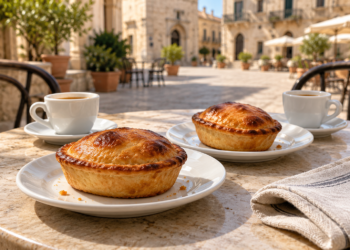
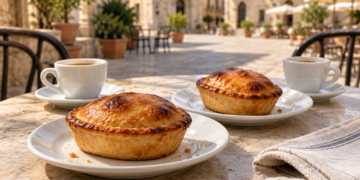





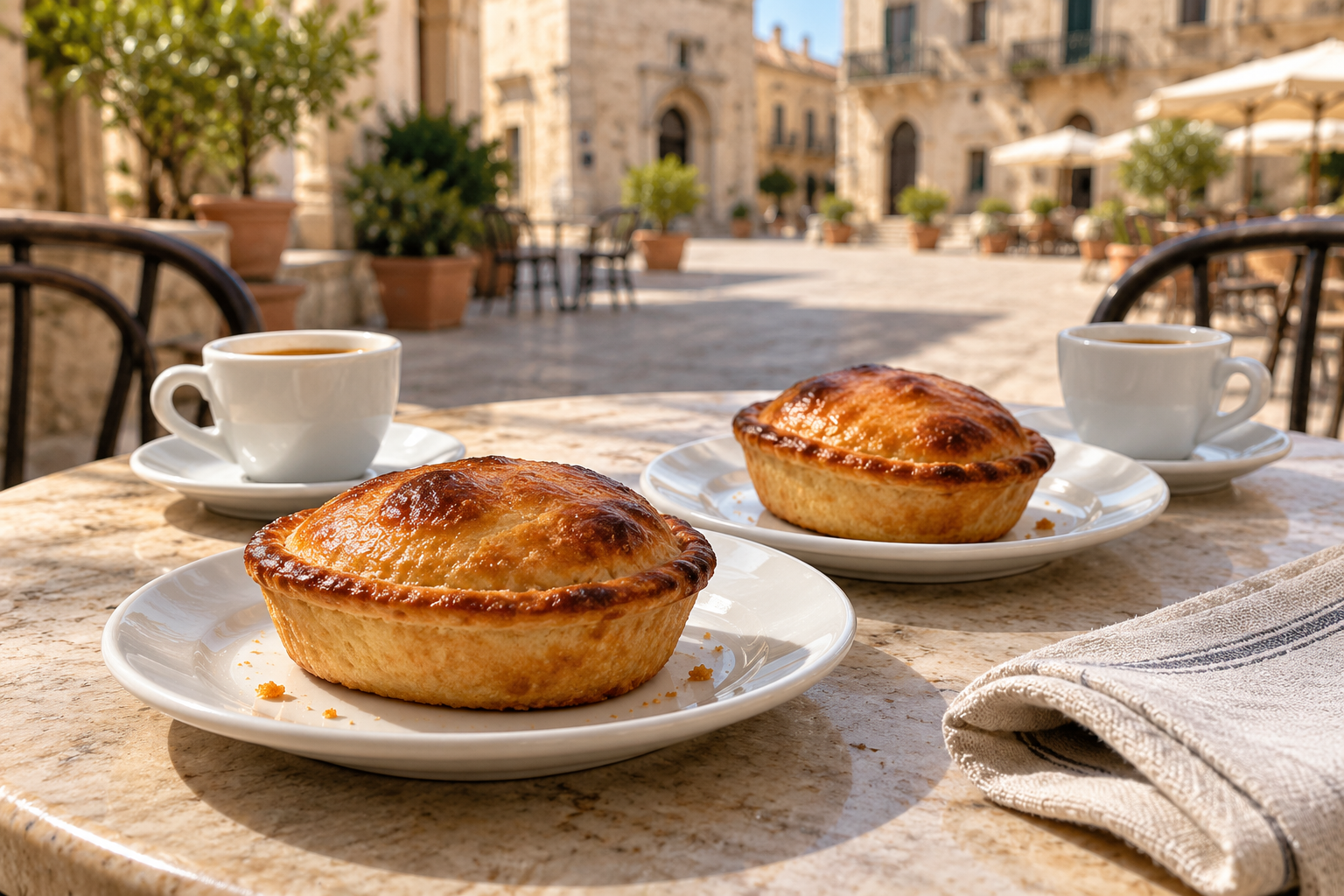
Pasticciotto is a small oval pastry with a golden shortcrust shell and a soft custard centre. It belongs to Salento, the southern part of Puglia, where a warm one with coffee is a familiar breakfast. You will see it in pastry counters across the region, but Lecce and nearby Galatina are the places most closely connected with it.
For a first taste, order the plain custard version. We explain what goes into a pasticciotto leccese, which variations to look for and where to stop for one during a trip through Puglia.
What is pasticciotto leccese
A pasticciotto leccese is an enclosed shortcrust pastry filled with crema pasticcera, the thick custard used in Italian baking. The top forms a little dome and turns a deep golden colour in the oven. Break it open and the shell should crumble around a generous, soft filling.
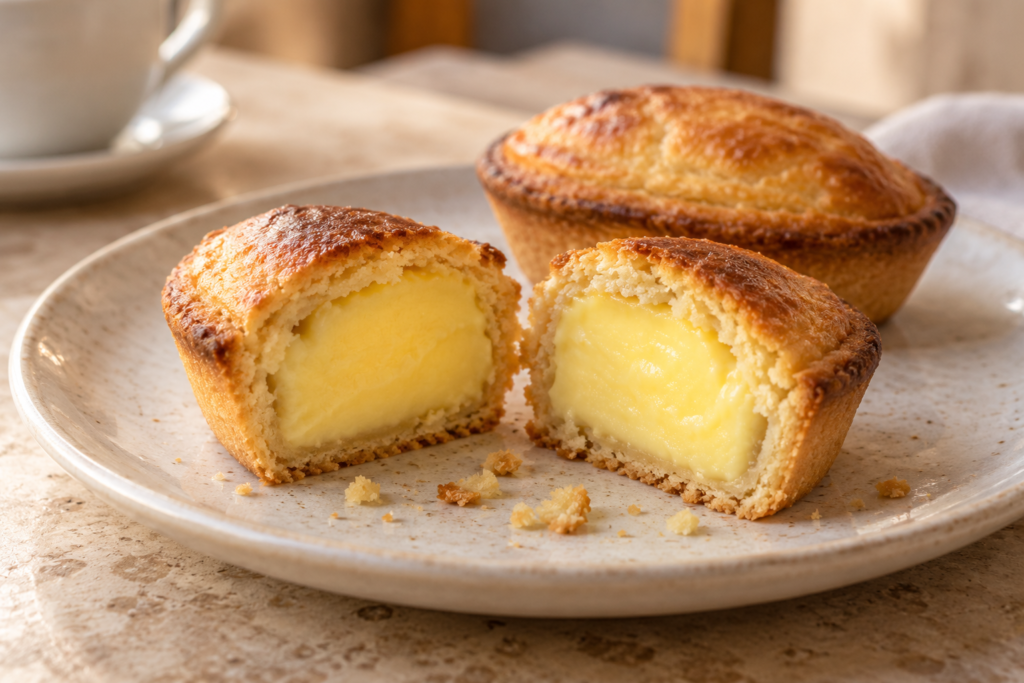
Pasta frolla is the Italian name for the pastry. Traditional recipes often use strutto, or lard, although butter versions are also made. The filling usually contains milk, egg yolks and sugar, thickened with flour or starch and flavoured with vanilla or lemon. Recipes vary between bakers, so a pronounced lemon flavour is not a requirement.
What is the difference between pasticciotto and pasticciotti
Pasticciotto is singular and pasticciotti is plural. They are the same pastry. You may also see pasticciotti leccesi, meaning pasticciotti associated with Lecce.
If you are ordering for two, “due pasticciotti alla crema” asks for two custard-filled pastries. Start with those before choosing a second filling to share.
Where does pasticciotto come from
Galatina is closely associated with its origin. The familiar story places its creation in the Ascalone family pastry shop in 1745, when leftover pastry and custard became a small cake.
The regional Puglia food archive describes that account as legend and tradition. It places the documented adoption of the custard version in Salento much later, probably towards the end of the nineteenth century. The connection with Galatina is part of the pastry’s identity, but the precise invention story should be treated as a story.
Which pasticciotto fillings can you try
Plain custard is the starting point, with other fillings depending on the bakery. If you want to compare two, choose one classic and one variation so you can taste how the filling changes the pastry.
| Version | Filling | What to expect |
| Classico or alla crema | Pastry custard | The straightforward version, with a crumbly shell and soft centre |
| Crema e amarena | Custard with sour cherries | A sharper fruit flavour through the sweet filling |
| Ricotta e pistacchio | Ricotta and pistachio | A cheese filling with a nut flavour |
Martinucci sells a ricotta and pistachio pasticciotto, while custard and cherry is another established variation. Availability at an individual counter can change.
You may also spot a fruttone beside the pasticciotti. Natale’s version contains almond paste and jam under a chocolate glaze. It is another Salento pastry worth trying, with a different filling from the classic custard one.
How do you eat pasticciotto in Puglia
Eat it warm enough for the custard to soften, after it has cooled sufficiently to handle. The contrast between the shortcrust and filling is the main pleasure. A very hot one needs a little patience before the first bite.
Coffee is the usual breakfast companion. For something local, try a caffè leccese, coffee served over ice with sweet almond milk. The almond milk used in this context is a sweet almond preparation, rather than necessarily the unsweetened plant drink sold in British supermarkets. Natale sells its own version for making the drink at home.
For an afternoon stop, one pastry each and a coffee is enough. You can try another bakery the next day rather than buying a large box that needs refrigeration.
Where to try pasticciotto in Puglia
Lecce makes an easy starting point, with two central addresses below. Add Galatina if the pastry’s history interests you, or stop in Gallipoli while exploring the coast.
| Place | Location | Why choose it |
| Pasticceria Andrea Ascalone | Via Vittorio Emanuele II 17, Galatina | The historic shop associated with the origin story |
| Caffè Alvino | Piazza Sant’Oronzo 30, Lecce | A central café opposite the Roman amphitheatre |
| Pasticceria Natale | Via Salvatore Trinchese 7, Lecce | A custard pasticciotto listed on its published menu |
| Martinucci Laboratory Centro Storico | Riviera Armando Diaz 129, Gallipoli | A stop in the old town, with a menu that includes pasticciotti |
Pasticceria Andrea Ascalone in Galatina
Pasticceria Andrea Ascalone is the address to choose if you want to connect the pastry with Galatina. The shop is on Via Vittorio Emanuele II, near the church of Saints Peter and Paul, and appears in Italy’s register of historic businesses.
Order a classic pasticciotto and leave time to walk around the town afterwards. Check the shop’s current opening arrangements before making a special journey, particularly if you plan to arrive later in the day.
Caffè Alvino in Lecce
Caffè Alvino is on Piazza Sant’Oronzo, facing the Roman amphitheatre. Its central location makes it a convenient breakfast stop before exploring Lecce on foot.
The café belongs to the Catamo family business and serves traditional pasticciotti alongside other sweet and savoury pastries. Its official website currently lists Tuesday as its closing day, so choose another day if Alvino is part of your plans.
Pasticceria Natale in Lecce
Pasticceria Natale is on Via Salvatore Trinchese, another useful address in central Lecce. Look for its Santo Pasticciotto, the bakery’s custard-filled version.
Its published menu also includes fruttone, so this is a practical place for two people to order one of each and compare them. The family business dates to 1978 and still makes the custard version alongside other Salento pastries.
Martinucci Laboratory in Gallipoli
The Martinucci Centro Storico branch is on Riviera Armando Diaz in Gallipoli’s old town. Its branch menu includes pasticciotti, making it a useful stop if your day is already taking you to the coast.
Martinucci also lists branches in Otranto, Bari and Alberobello. Check the location nearest your route rather than travelling across Puglia solely for a chain branch. Ask which fillings are available that day, especially if you want something beyond custard.
How much does a pasticciotto cost
As a specific price reference, Natale’s online menu lists its Santo Pasticciotto at €2.50 when checked in October 2026. That is one bakery’s published price, rather than a fixed price across Puglia.
Coffee costs extra. If you plan to sit outside, check the table menu before ordering so you know the price for your chosen service. Flavoured versions and different sizes can also have separate prices.
How do you make pasticciotti at home
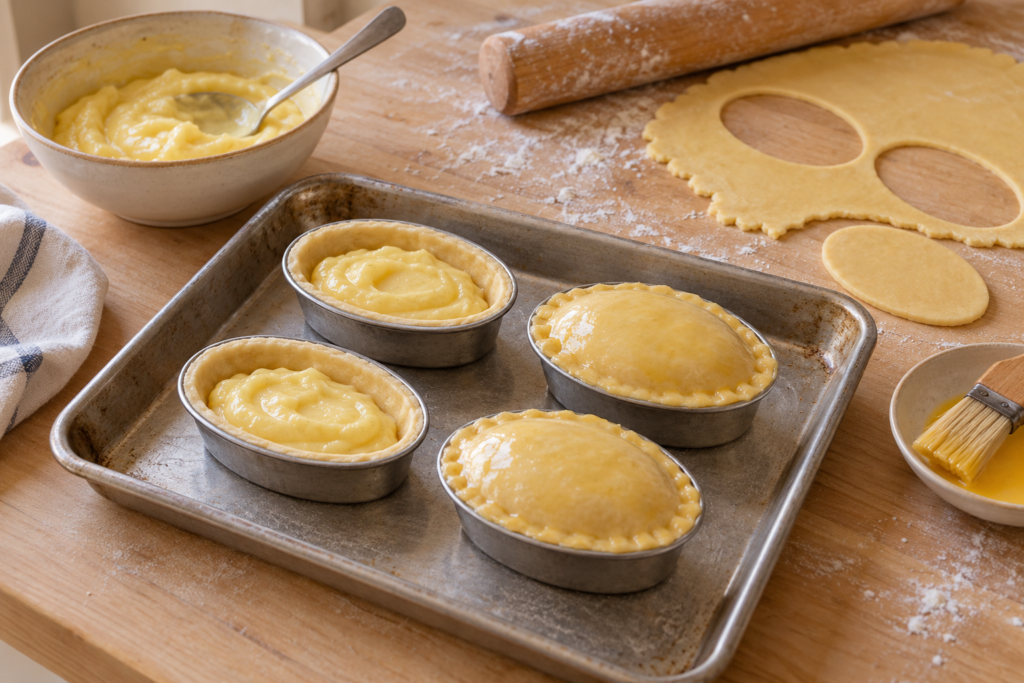
This butter-based pasticciotto recipe is adapted from GialloZafferano’s version, with cherries omitted. It makes about 15 pastries in oval moulds approximately 7cm long and 3cm deep.
For the pastry, use 500g 00 flour, 250g cold butter, 200g icing sugar, four egg yolks and the seeds of one vanilla pod.
For the custard, use 500ml milk, six egg yolks, 150g caster sugar, 50g 00 flour and one vanilla pod. For glazing, mix one egg yolk with three tablespoons of cream.
Warm the milk with vanilla. Whisk custard yolks, sugar and flour, then gradually whisk in the warm milk. Return to low heat and stir until thick. Cover and chill.
Rub the butter into the pastry flour. Add icing sugar, yolks and vanilla, bring together briefly and refrigerate for at least 30 minutes.
Roll out and line buttered, floured moulds. Add custard, leaving room to seal the lids.
Cover with pastry, press the edges closed and brush with glaze.
Bake in a preheated conventional oven at 180°C for 30 to 35 minutes until golden. Cool before removing and eating.
How long do pasticciotti keep
Refrigerate cooled homemade pastries in a sealed container and eat within three days.
Fresh pastries are best planned around when you want to eat them. Buy one for breakfast or a small number for later, rather than carrying custard-filled pastries around in a warm car all day.
Storage instructions depend on the producer. For example, Martinucci says its chilled delivery pasticciotti can be refrigerated for two days or frozen for two months. Those instructions apply to its packaged product. Follow the bakery’s advice for what you buy, including any instructions for reheating.
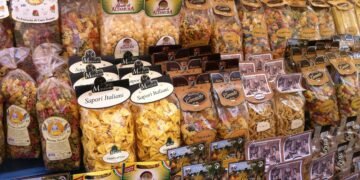
If you want food gifts that travel more easily, our guide to what to buy in an Italian supermarket has ideas for the rest of your shopping.
Trying pasticciotto at the source
For a short stay, choose a Lecce café and give yourself time for breakfast before sightseeing. For a longer Salento trip, add Galatina as a separate town stop and try the pastry associated with its history. Gallipoli is an alternative when your plans already include the coast.
Our Italy travel guide can help you place Puglia within a wider trip. If you are exploring Italian food and drink through its regional specialities, our Meloncello and Limoncello guide explains two other names you will find during your travels.
FAQs
What does pasticciotto taste like
It tastes sweet and rich, with crumbly pastry around a smooth custard filling. Vanilla and sometimes lemon flavour the classic version, while cherry adds a sharper note.
Is pasticciotto vegetarian
Check before ordering. Traditional pastry often contains lard, so a custard filling does not automatically make it vegetarian. Butter-based versions exist, but ask the bakery which fat it uses.
Does pasticciotto contain nuts
A plain version does not necessarily contain nuts, but pistachio and almond variations do. Bakeries may handle nuts alongside other pastries. If you have an allergy, ask staff about the ingredients and preparation of the specific product.
Is pasticciotto the same as a Portuguese custard tart
No. A Portuguese pastel de nata has an open top and a layered pastry shell. Pasticciotto has shortcrust pastry enclosing the custard, including a pastry lid.
Can you find pasticciotti outside Lecce
Yes. They are sold elsewhere in Puglia and beyond. Lecce and Galatina have the closest connection with the pastry, while the Gallipoli address above is useful for a coastal stop.